




Makes your data queryable, traceable, reproducible, and FAIR. One API: lakehouse, lineage, feature store, ontologies, LIMS, ELN.
Why?
Reproducing analytical results or understanding how a dataset or model was created can be a pain. Training models on historical data, LIMS & ELN systems, orthogonal assays, or datasets from other teams is even harder. Even maintaining an overview of a project's datasets & analyses is more difficult than it should be.
Biological datasets are typically managed with versioned storage systems, GUI-focused platforms, structureless data lakes, rigid data warehouses (SQL, monolithic arrays), or tabular lakehouses.
LaminDB extends the lakehouse architecture to biological registries & datasets beyond tables (DataFrame, AnnData, .zarr, .tiledbsoma, …).
It provides enough structure to enable queries across many datasets, enough freedom to keep the pace of R&D high, and rich context in form of data lineage and metadata for humans and AI.
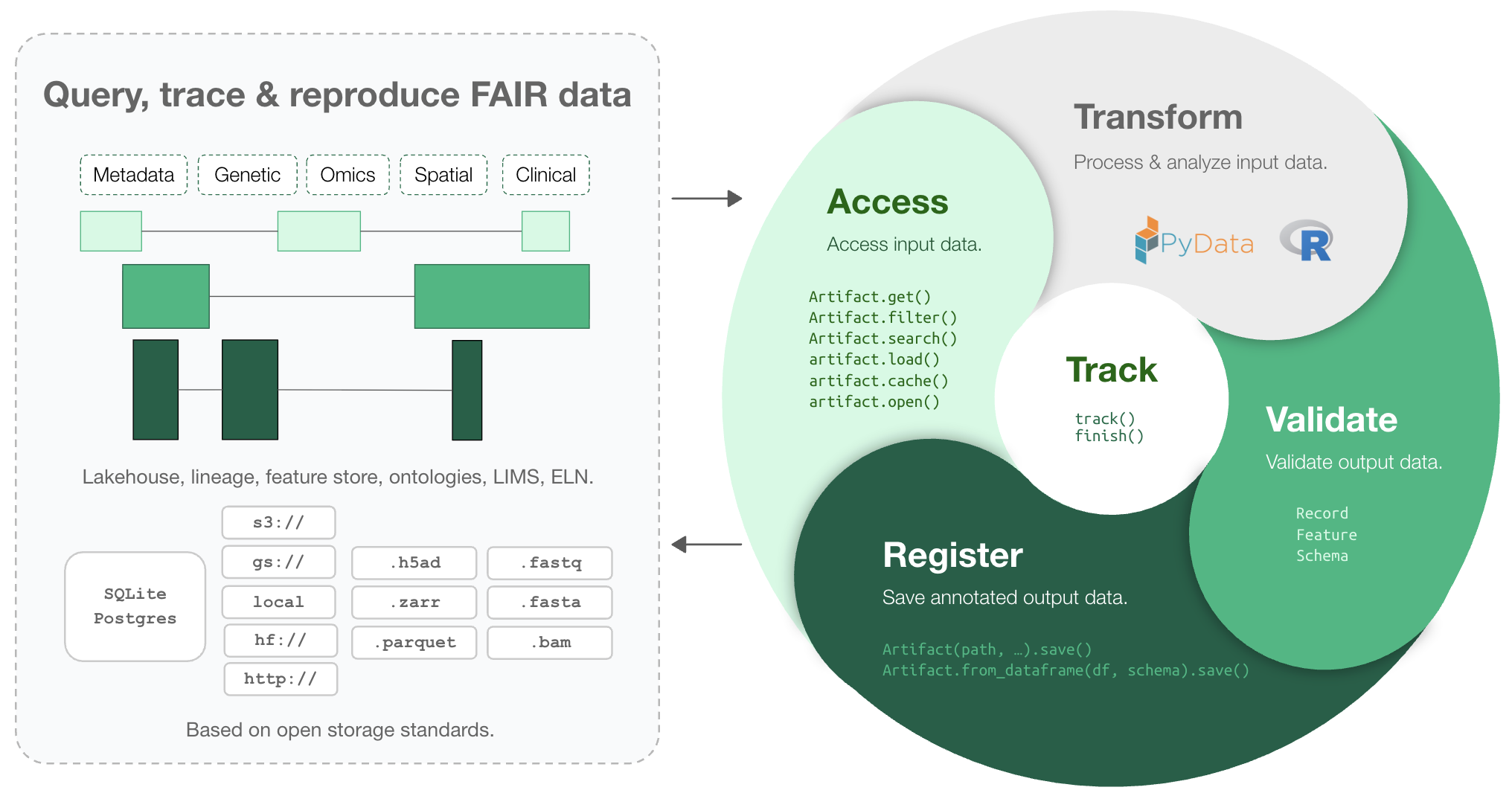
Highlights:
- lineage → track inputs & outputs of notebooks, scripts, functions & pipelines with a single line of code
- lakehouse → manage, monitor & validate schemas; query across many datasets
- feature store → manage features & labels; leverage batch loading
- FAIR datasets → validate & annotate
DataFrame,AnnData,SpatialData,parquet,zarr, … - LIMS & ELN → manage experimental metadata, ontologies & markdown notes
- unified access → storage locations (local, S3, GCP, …), SQL databases (Postgres, SQLite) & ontologies
- reproducible → auto-track source code & compute environments, auto-version data, code & reports
- zero lock-in & scalable → runs in your infrastructure; not a client for a rate-limited REST API
- integrations → vitessce, nextflow, redun, and more
- extendable → create custom plug-ins based on the Django ORM
If you want a GUI: LaminHub is a data collaboration hub built on LaminDB similar to how GitHub is built on git.
Who uses it?
Scientists & engineers in pharma, biotech, and academia, including:
- Pfizer – A global BigPharma company with headquarters in the US
- Ensocell Therapeutics – A BioTech with offices in Cambridge, UK, and California
- DZNE – The National Research Center for Neuro-Degenerative Diseases in Germany
- Helmholtz Munich – The National Research Center for Environmental Health in Germany
- scverse – An international non-profit for open-source omics data tools
- The Global Immunological Swarm Learning Network – Research hospitals at U Bonn, Harvard, MIT, Stanford, ETH Zürich, Charite, Mount Sinai, and others
Copy summary.md into an LLM chat and let AI explain or read the docs.
Install the Python package:
pip install lamindbBrowse databases at lamin.ai/explore, e.g., lamin.ai/laminlabs/cellxgene. To query it:
import lamindb as ln

db = ln.DB("laminlabs/cellxgene")  # a database object for queries
df = db.Artifact.to_dataframe()    # a dataframe listing datasets & models
Let's get a dataset for Alzheimer's disease:
artifact = db.Artifact.get("BnMwC3KZz0BuKftR")  # a metadata object for a dataset
artifact.describe()                             # describe metadata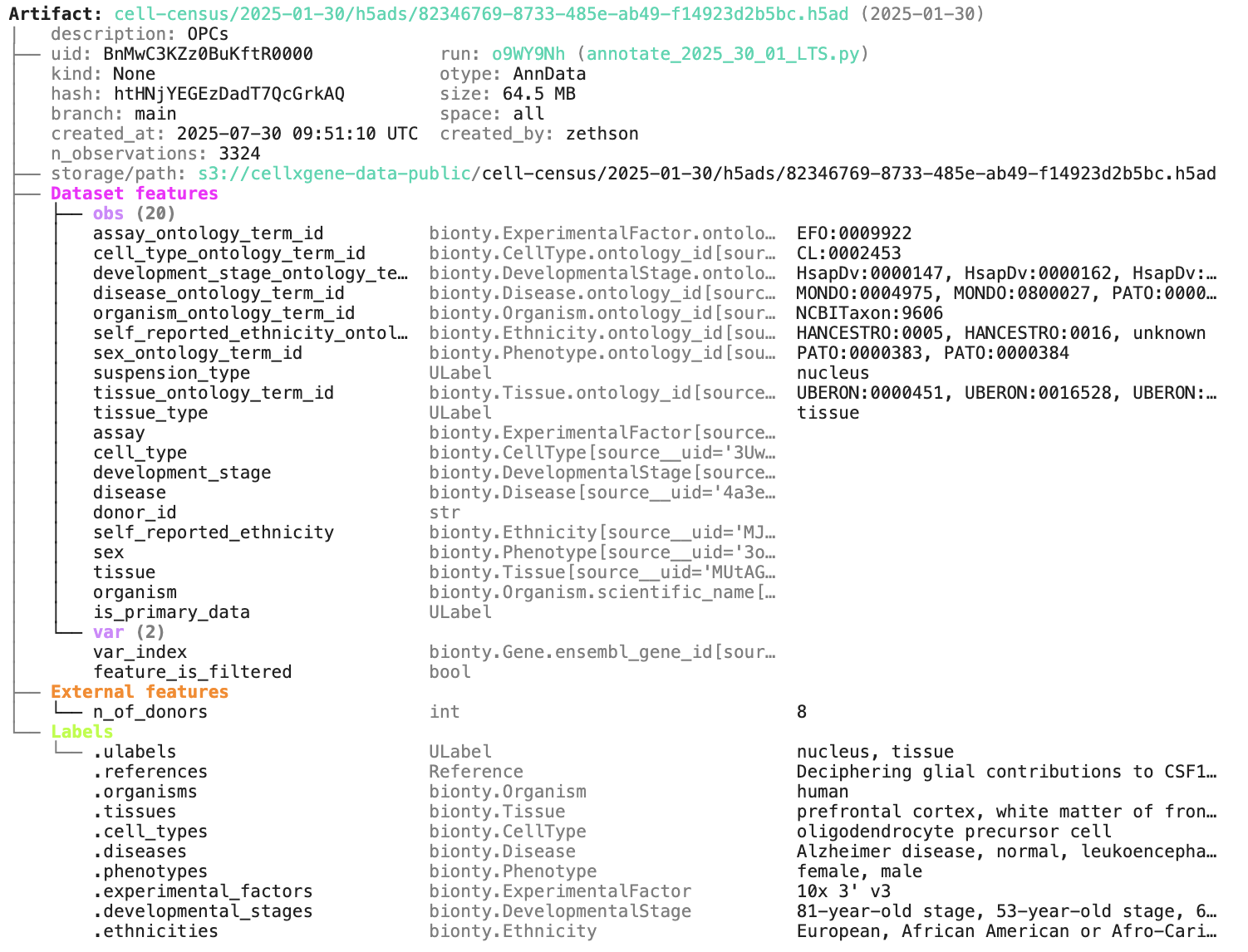
Access the content of the artifact via:
local_path = artifact.cache()  # return a local path from a cache
adata = artifact.load()        # load object into memory
accessor = artifact.open()     # return a streaming accessor
If you want to query other types of entities, e.g., diseases, here is how to do it:
diseases = db.bionty.Disease.lookup()    # a lookup object to auto-complete diseases
df = db.Artifact.filter(
    diseases=diseases.alzheimer_disease  # filter by fields
).to_dataframe()
This is how you can query 14 built-in registries in lamindb (Artifact, Storage, Feature, Record, etc.) and 13 biological entities in bionty (Disease, CellType, Tissue, etc.) mapping >20 public ontologies. To learn what you can query by, call:
db.Artifact.describe()You can create a LaminDB instance at lamin.ai and invite collaborators. To connect to a remote instance, run:
lamin login
lamin connect account/name
If you prefer to work with a local SQLite database (no login required), run this instead:
lamin init --storage ./quickstart-data --modules biontyOn the terminal and in a Python session, LaminDB will now auto-connect.
To save a file or folder from the command line, run:
lamin save myfile.txt --key examples/myfile.txtTo load the file, run:
lamin load --key examples/myfile.txtTo create a dataset while tracking source code, inputs, outputs, logs, and environment:
import lamindb as ln
# → connected lamindb: account/instance

ln.track()                                              # track code execution
open("sample.fasta", "w").write(">seq1\nACGT\n")        # create dataset
ln.Artifact("sample.fasta", key="sample.fasta").save()  # save dataset
ln.finish()                                             # mark run as finished
Running this snippet as a script (python create-fasta.py) produces the following data lineage:
artifact = ln.Artifact.get(key="sample.fasta")  # get artifact by key
artifact.view_lineage()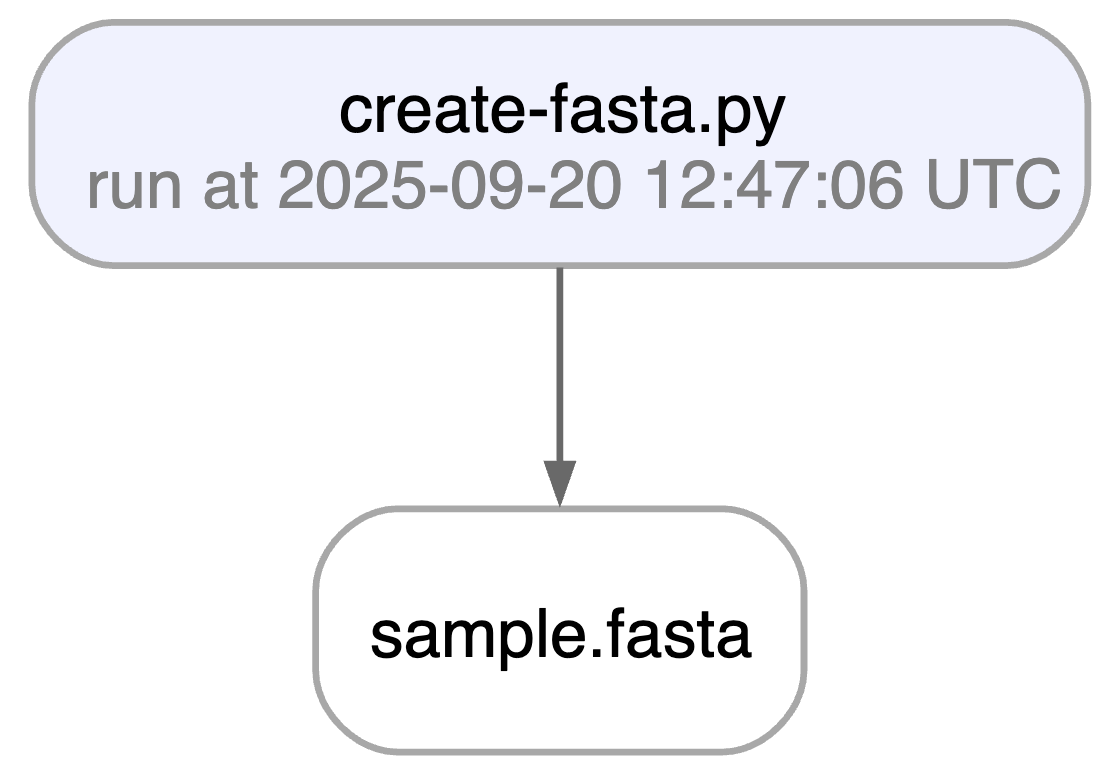
You'll know how that artifact was created and what it's used for.
artifact.describe()
Here is how to access the data lineage context:
run = artifact.run                  # get the run record
transform = artifact.run.transform  # get the transform record
Examples for run & transform.
run.describe()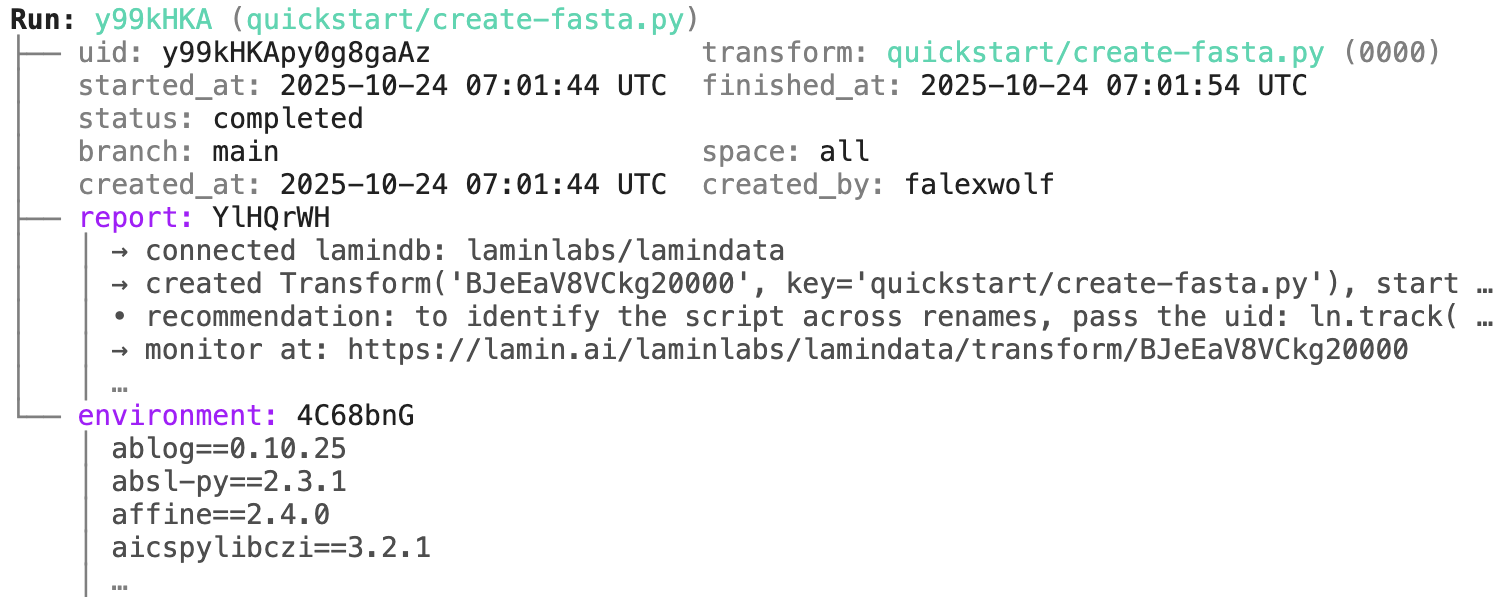
transform.describe()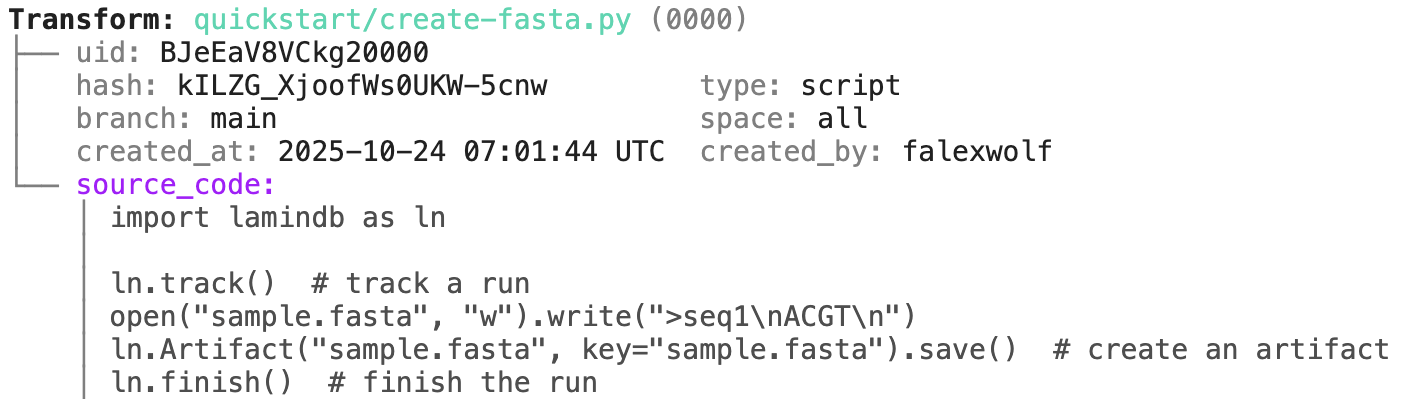
You can label an artifact by running:
my_label = ln.ULabel(name="My label").save()   # a universal label
project = ln.Project(name="My project").save() # a project label
artifact.ulabels.add(my_label)
artifact.projects.add(project)
Query for it:
ln.Artifact.filter(ulabels=my_label, projects=project).to_dataframe()You can also query by the metadata that lamindb automatically collects:
ln.Artifact.filter(run=run).to_dataframe()                # query all artifacts created by a run
ln.Artifact.filter(transform=transform).to_dataframe()    # query all artifacts created by a transform
ln.Artifact.filter(size__gt=1e6).to_dataframe()           # query all artifacts bigger than 1MB
If you want to include more information into the resulting dataframe, pass include.
ln.Artifact.to_dataframe(include=["created_by__name", "storage__root"]) # include fields from related registriesNote: The query syntax for DB objects and for your default database is the same.
You can annotate datasets and samples with features. Let's define some:
from datetime import date

ln.Feature(name="gc_content", dtype=float).save()
ln.Feature(name="experiment_note", dtype=str).save()
ln.Feature(name="experiment_date", dtype=date).save()
During annotation, feature names and data types are validated against these definitions:
artifact.features.add_values({
    "gc_content": 0.55,
    "experiment_note": "Looks great",
    "experiment_date": "2025-10-24",
})
Now that the data is annotated, you can query for it:
ln.Artifact.filter(experiment_date="2025-10-24").to_dataframe() # query all artifacts annotated with `experiment_date`If you want to include the feature values into the dataframe, pass include.
ln.Artifact.to_dataframe(include="features") # include the feature annotationsYou can create records for the entities underlying your experiments: samples, perturbations, instruments, etc., for example:
sample = ln.Record(name="Sample", is_type=True).save()  # type sample
ln.Record(name="P53mutant1", type=sample).save()        # sample 1
ln.Record(name="P53mutant2", type=sample).save()        # sample 2
Define the corresponding features and annotate:
ln.Feature(name="design_sample", dtype=sample).save()
artifact.features.add_values({"design_sample": "P53mutant1"})
You can query & search the Record registry in the same way as Artifact or Run.
ln.Record.search("p53").to_dataframe()You can also create relationships of entities and -- if you connect your LaminDB instance to LaminHub -- edit them like Excel sheets in a GUI.
If you change source code or datasets, LaminDB manages their versioning for you.
Assume you run a new version of our create-fasta.py script to create a new version of sample.fasta.
import lamindb as ln

ln.track()
open("sample.fasta", "w").write(">seq1\nTGCA\n")  # a new sequence
ln.Artifact("sample.fasta", key="sample.fasta", features={"design_sample": "P53mutant1"}).save()  # annotate with the new sample
ln.finish()
If you now query by key, you'll get the latest version of this artifact.
artifact = ln.Artifact.get(key="sample.fasta")  # get artifact by key
artifact.versions.to_dataframe() # see all versions of that artifactHere is how you ingest a DataFrame:
import pandas as pd

df = pd.DataFrame({
    "sequence_str": ["ACGT", "TGCA"],
    "gc_content": [0.55, 0.54],
    "experiment_note": ["Looks great", "Ok"],
    "experiment_date": [date(2025, 10, 24), date(2025, 10, 25)],
})
ln.Artifact.from_dataframe(df, key="my_datasets/sequences.parquet").save()  # no validation
To validate & annotate the content of the dataframe, use a built-in schema:
ln.Feature(name="sequence_str", dtype=str).save()  # define a remaining feature
artifact = ln.Artifact.from_dataframe(
    df,
    key="my_datasets/sequences.parquet",
    schema="valid_features"  # validate columns against features
).save()
artifact.describe()
Now you know which schema the dataset satisfies. You can filter for datasets by schema and then launch distributed queries and batch loading.
To validate an AnnData with a built-in schema call:
import anndata as ad
import numpy as np

adata = ad.AnnData(
    X=pd.DataFrame([[1]*10]*21).values,
    obs=pd.DataFrame({'cell_type_by_model': ['T cell', 'B cell', 'NK cell'] * 7}),
    var=pd.DataFrame(index=[f'ENSG{i:011d}' for i in range(10)])
)

artifact = ln.Artifact.from_anndata(
    adata,
    key="my_datasets/scrna.h5ad",
    schema="ensembl_gene_ids_and_valid_features_in_obs"
)
artifact.describe()
To validate a spatialdata or any other array-like dataset, you need to construct a Schema. You can do this by composing the schema of a complicated object from simple pandera/pydantic-like schemas: docs.lamin.ai/curate.
Plugin bionty gives you >20 of them as SQLRecord registries. This was used to validate the ENSG ids in the adata just before.
import bionty as bt

bt.CellType.import_source()  # import the default ontology
bt.CellType.to_dataframe() # your extendable cell type ontology in a simple registryLaminDB is not a workflow manager, but it integrates well with existing workflow managers and can subsitute them in some settings.
In github.com/laminlabs/schmidt22 we manage several workflows, scripts, and notebooks to re-construct the project of Schmidt el al. (2022). A phenotypic CRISPRa screening result is integrated with scRNA-seq data. Here is one of the input artifacts:
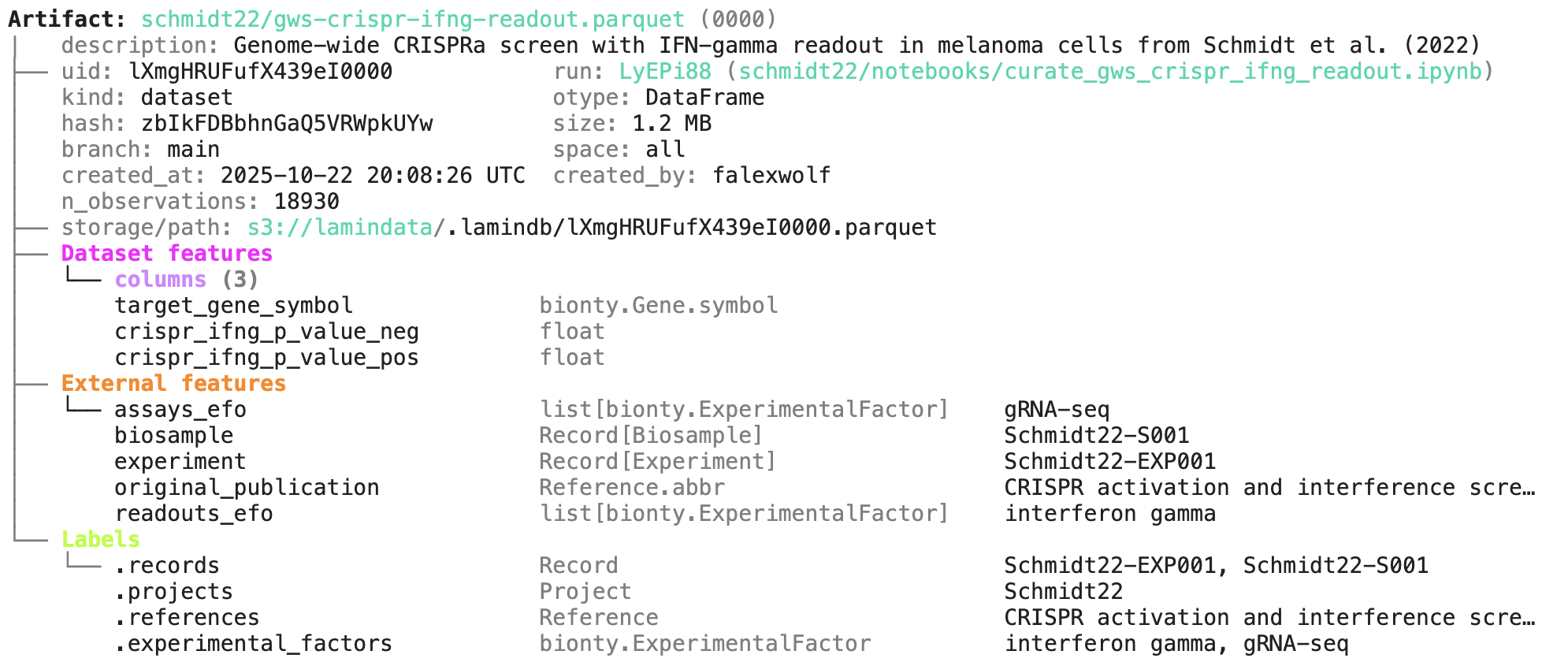
And here is the lineage of the final result:
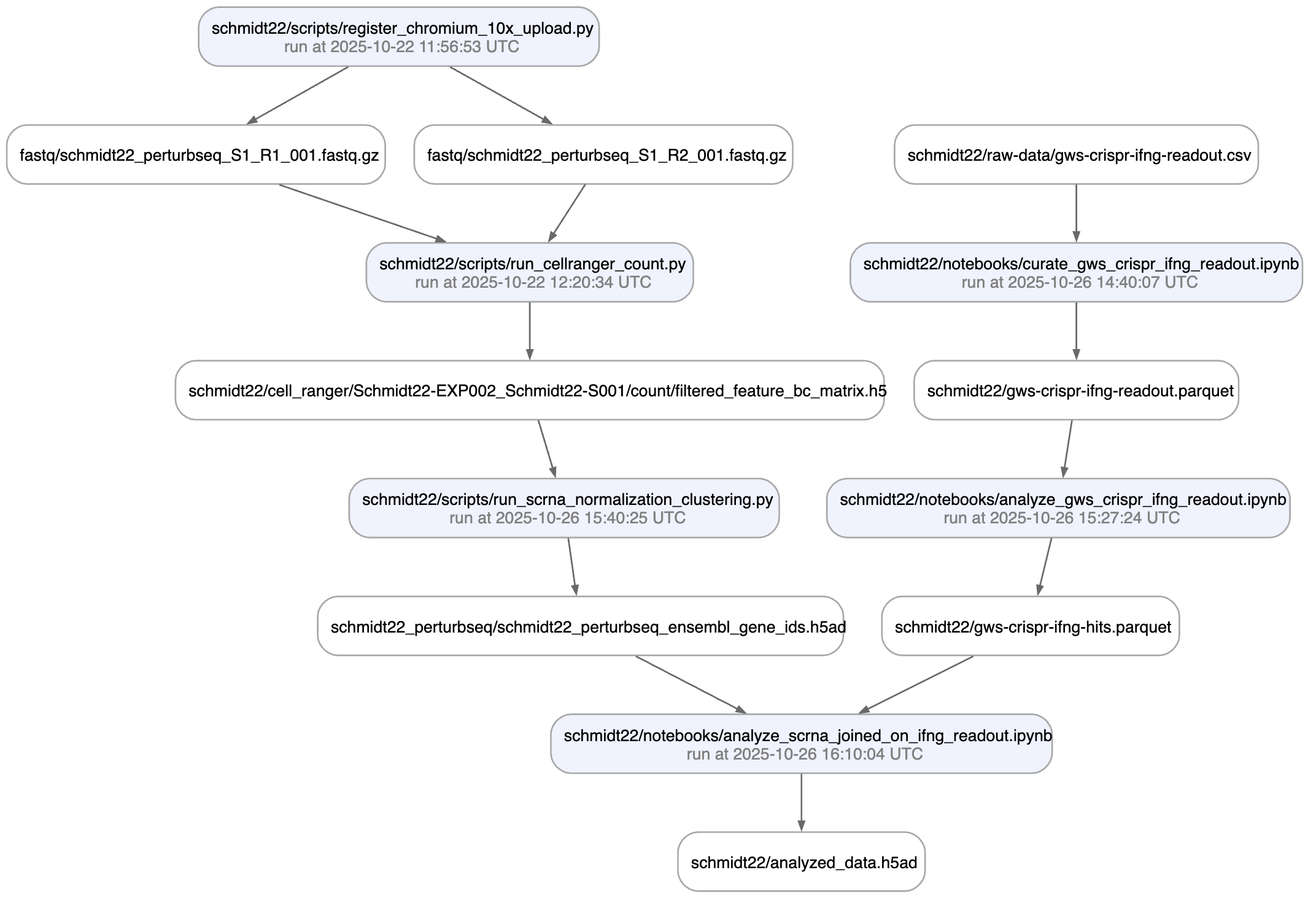
You can explore it here.
If you'd like to integrate with Nextflow, Snakemake, or redun, see here: docs.lamin.ai/pipelines